

BACK TO BLOG
My Wife Said I Grind My Teeth at Night. I Ignored Her for Two Years.
I'm Mike, and the first person to diagnose my dental problem was not a dentist. It was my wife, at roughly 2 a.m., elbowing me awake to tell me the grinding sound was back.
I did what I suspect a lot of people do with information delivered at 2 a.m. I apologized, rolled over, and ignored it. For two years. In my defense, I felt fine. In reality, I was waking up most mornings with a dull ache in my jaw that I blamed on sleeping wrong, and tension headaches at my temples that I blamed on my commute down Peachtree Road and a job that lives in my inbox. I had an explanation for everything. None of my explanations were correct.
What finally got me was a routine cleaning at Brookhaven Village Dentistry. I hadn't mentioned the grinding, because I'd genuinely forgotten it was a thing my wife kept telling me. Dr. Scarlett looked at my teeth and asked, unprompted, how long I'd been grinding at night.
My teeth had been keeping a record the whole time.
How my dentist knew without being told
This is the part I found fascinating once I stopped being embarrassed. Grinding leaves evidence that's obvious to a trained eye.
My back teeth had flattened spots called wear facets, places where the chewing surfaces had been ground smooth against each other like sea glass. The edges of my front teeth had worn level and slightly thin. There were faint vertical lines in the enamel, early stress cracks from years of pressure. And my cold sensitivity, which I'd chalked up to getting older, traced back to enamel worn thin enough that temperature was reaching the layer underneath.
The condition is called bruxism, and the numbers Dr. Scarlett shared reframed it for me completely. Normal chewing puts modest force on your teeth, and your reflexes protect you from biting too hard. Asleep, those protective reflexes are off, and nighttime grinding can generate several times the force of chewing, applied for hours, against teeth that were never designed for it. I was essentially doing demolition work in my sleep, every night, for years.
It also explained the mornings. The jaw ache was my muscles, exhausted from a night of clenching. The temple headaches were the same muscles complaining further up. The commute was innocent. Mostly.
Why I didn't just buy the drugstore guard
My first instinct, being me, was to solve this for thirty dollars at the pharmacy. I asked about the boil-and-bite guards directly, and the answer was more even-handed than I expected.
A drugstore guard is better than nothing as a stopgap. But they're bulky, they fit loosely, plenty of people unconsciously chew on them or spit them out at night, and the soft ones can actually give your jaw something satisfying to gnaw, which works the muscles harder rather than resting them. They also wear through quickly under a serious grinder, and the marks I'd already put in my own enamel suggested I qualified.
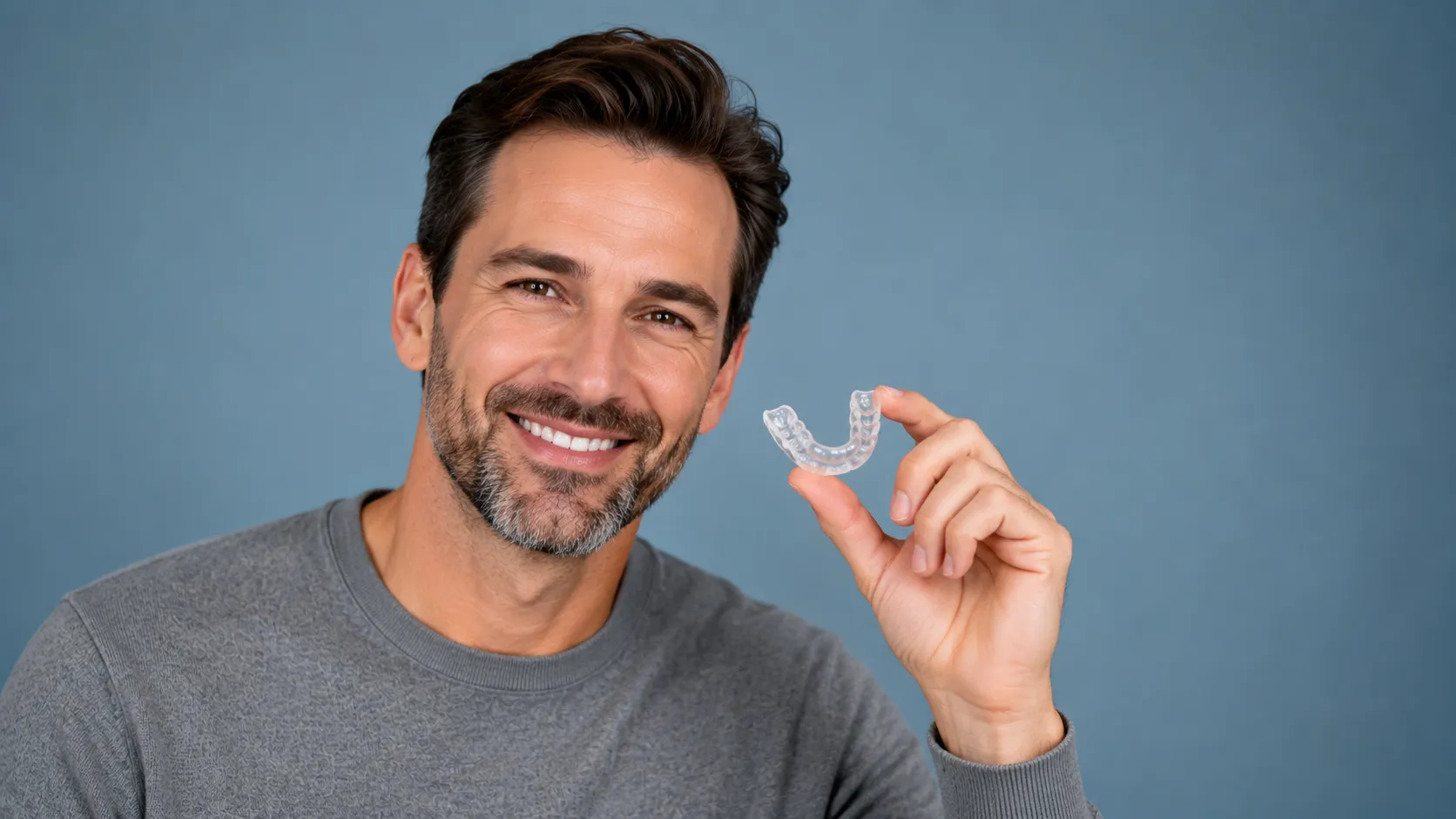
A custom night guard is made from impressions of your actual teeth, fits precisely, holds your jaw in a position that lets the muscles relax, and puts a durable layer between your upper and lower teeth so the guard absorbs the force instead of your enamel. The grinding doesn't necessarily stop. The damage does.
I got the custom one. Two short visits: an impression, then a fitting a couple of weeks later with small adjustments until it sat right.
What changed, and what I had to accept
The first week felt strange, like falling asleep with a small retainer in my mouth. By week two I stopped noticing it. By week three, something I hadn't predicted: the morning jaw ache was just gone. The temple headaches went from a few times a week to rare. My wife reports the 2 a.m. sound is muffled to almost nothing, which I consider a marriage dividend on top of the dental one.
What I had to accept is that the guard protects against grinding but doesn't cure it. Bruxism is strongly tied to stress, and it can also travel with sleep issues like sleep apnea, which is why Dr. Scarlett asked me screening questions about snoring and daytime tiredness before settling on the guard. For some people, the grinding conversation becomes a sleep conversation, and it's worth having both.
The cracked enamel and worn spots I'd already earned don't repair themselves. We're watching two teeth that may eventually want crowns. That's the cost of my two years of ignoring the problem, and it's the entire reason I'm writing this. The guard I eventually got costs a fraction of the dental work I was steadily creating the need for.
Questions I had that you might have too
How do I know if I grind my teeth at night? Ask whoever sleeps near you, then believe them faster than I did. Solo sleepers: morning jaw soreness, dull temple headaches, unexplained tooth sensitivity, and flattened or chipped edges are the classic signs, and a dentist can read the evidence directly off your teeth at a checkup.
What does a custom night guard cost in the Brookhaven area? Typically somewhere in the $300 to $800 range depending on the type, and some dental plans cover part of it. The drugstore version is cheaper up front and considerably more expensive if it fails to prevent the crown-and-root-canal future you're grinding toward.
Will a night guard stop the grinding? Not necessarily, and that's okay. Its job is to absorb the force so your teeth don't. Reducing stress, improving sleep, and treating any underlying sleep disorder are how the grinding itself gets addressed.
Is grinding related to TMJ problems? They're close cousins. Chronic grinding strains the jaw joint and can cause or worsen TMJ pain, clicking, and stiffness. My morning jaw ache was the early edge of that, and the guard relieved it.
Can kids grind their teeth? Yes, it's actually common in children and many outgrow it, but it's worth mentioning at their checkup.
If someone keeps telling you that you grind
If you're in Brookhaven, Drew Valley, Ashford Park, or anywhere nearby, and someone who shares your bedroom has mentioned the sound more than once, do the thing I didn't do for two years. Mention it at your next cleaning, or just book one at Brookhaven Village Dentistry and ask. The exam is easy, the evidence is already written on your teeth, and the fix is two short visits.
My wife was right, by the way. She has the night guard receipt framed as proof. I've decided the headache-free mornings are worth it.
Let’s Get You Smiling!
Schedule your visit and see why so many neighbors trust our team. We can’t wait to meet you.